
SS TEXACO OKLAHOMA March 27 1971
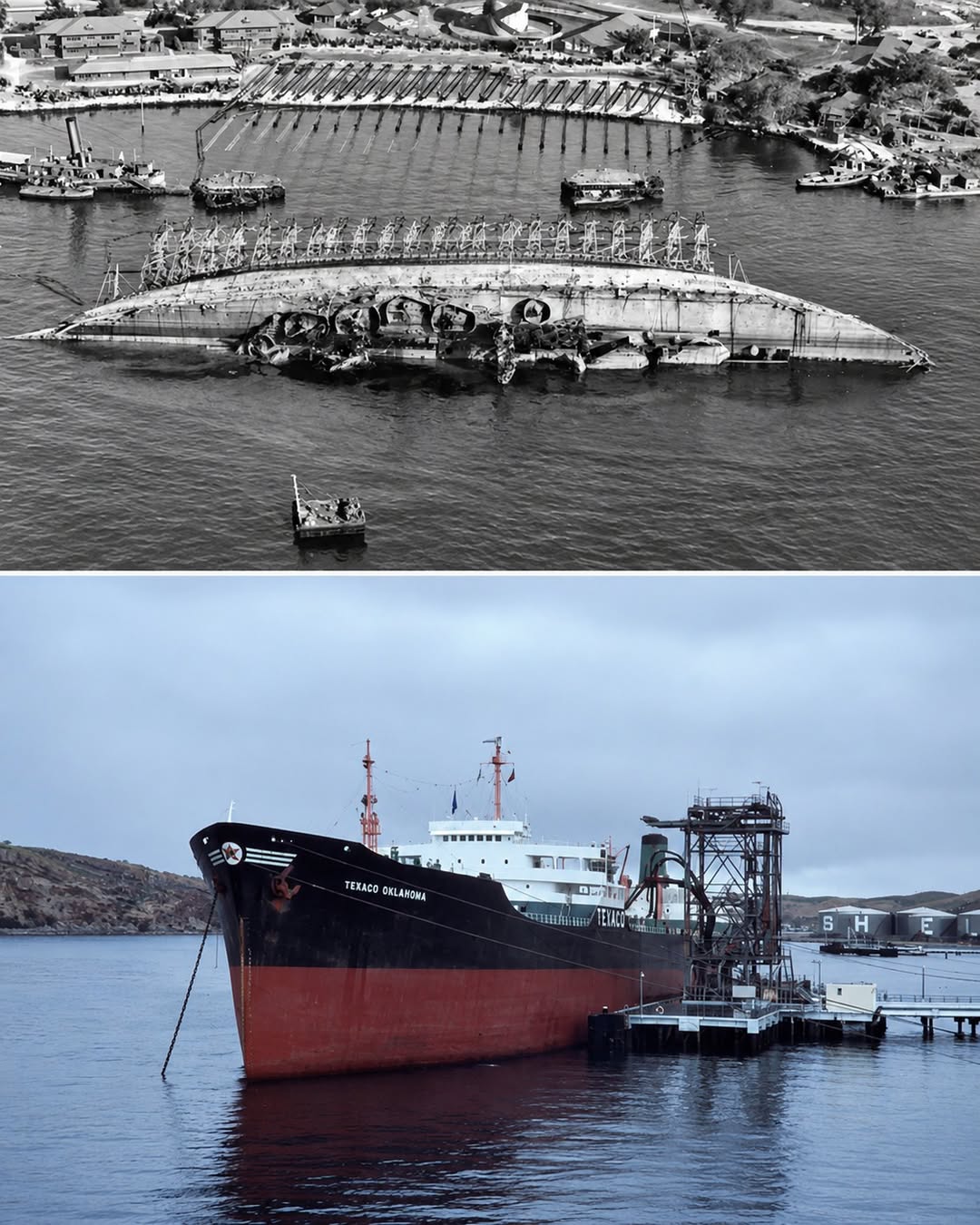
SS TEXACO OKLAHOMA March 27 1971
“At 0330, March 27, 1971, the tanker SS Texaco Oklahoma, fully loaded with a cargo of 33,000 tons of black oil, broke in two about 120 miles northeast of Cape Hatteras, North Carolina (off the Outer Banks).
The ship built in 1958, was the largest in the Texaco fleet at the time. The ship was en route from Port Arthur, Texas, to Boston, Massachusetts, and was proceeding at very slow speed in a severe storm when the casualty occurred.
There were 44 crew members on board.
The ship split in the vicinity of No. 5 tanks and submerged all the crew asleep in the forward deckhouse. The forward section then reversed direction and drifted down on the stern section, destroying the starboard lifeboat before the stern section was backed safely away. None of the 13 crew-members on the forward section survived.
The crew members on the stern section attempted to attract passing ships by firing flares, blinking white and red lights, and sounding the ship’s whistle.
One ship responded to the light signals but no distress signals were identified and she departed. The crew also operated the portable lifeboat radio transmitter for at least 12 hours without knowing that distress signals were not being received.
The stern section sank at about 0600 Sunday, March 28, which was the time the ship was scheduled to arrive in Boston and 27 hours after the ship broke in two. The crewmembers abandoned the stern, using one 15-person inflatable raft and two rafts improvised from empty oil drums. About 10 hours later, a merchant vessel discovered the raft, rescued 11 survivors, and initiated an extensive rescue effort. Subsequently, two more crewmembers who had been in the water about 32 hours were rescued. Thirty-one of the 44 crewmembers perished in this casualty.”
The National Transportation Safety Board determined that the probable cause of the Texaco-Oklahoma hull fracture was the high stresses produced by heavy seas and other forces on the relatively lightly constructed, fully loaded ship. The design, maintenance, and operating standards inherently contained risk levels which were excessive for vessels of this type transiting the seas off Cape Hatteras in winter storms.
The disaster led to stricter U.S. Coast Guard and NTSB maritime safety regulations, mandatory exposure suits, and the phase-out of older WWII-era tankers. A memorial sundial was erected in Port Arthur, Texas.
Source: Various