
First 10,000 Unit Car Carrier Delivered by China to Hyundai Glovis
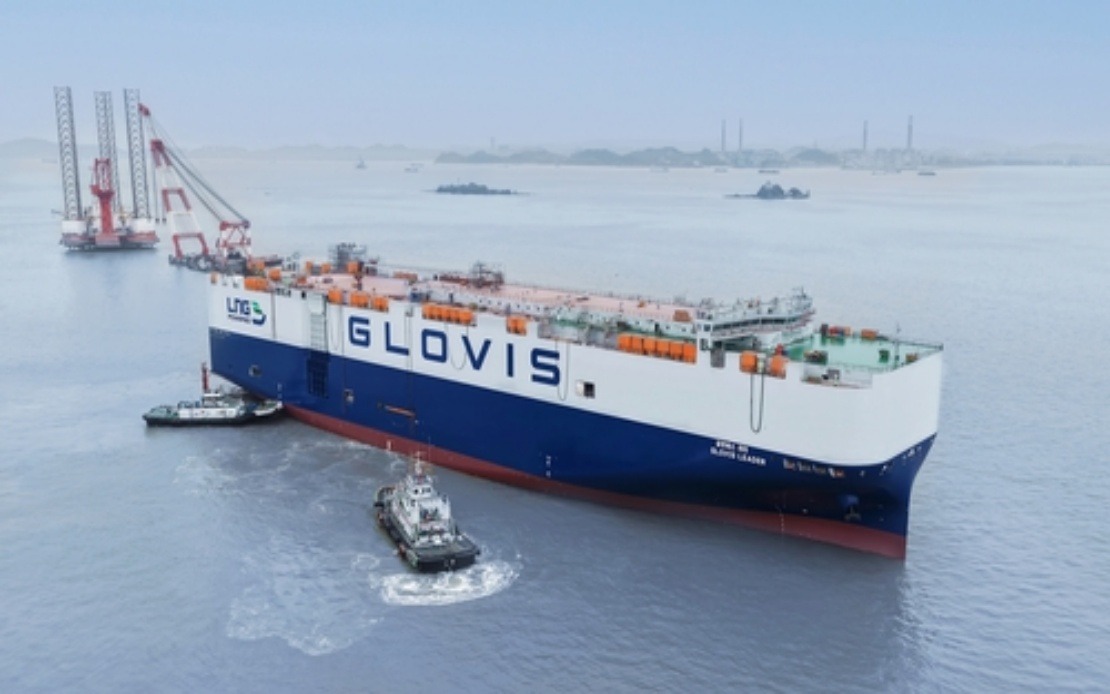
The first car and vehicle carrier in the world to exceed 10,000 units was officially delivered on April 28, marking a new milestone as the sector continues to build out capacity to meet the demand for exports from Asia. In addition to its capacity, the vessel is notable as it is owned by South Korea’s HMM and part of a strategy by Hyundai Glovis to expand and diversify its operations.
Named Glovis Leader, the pure car and truck carrier (PCTC) was built by China’s Guangzhou Shipyard International (GSI) as the first of a series for the South Korean partnership. It measures 230 meters (755 feet) with a beam of 40 meters (131 feet) and 14 cargo decks. The vessel, which is 20,000 dwt / 102,588 gross tons and registered in Panama, was designed to transport a broad range of vehicles, including electric, hydrogen, and heavy trucks, with a total capacity of 10,800 standard-sized vehicles.
The new ship is equipped with dual-fuel engines able to operate on LNG or conventional fuels. It also has shaft generators and is capable of using shore power while in port. It will have a cruising speed of 19 knots.
HMM entered into the order to build the ships as part of its strategy to diversify beyond container shipping. The ships will operate under long-term charters to Hyundai Glovis, which points to a strategy to expand its fleet to 128 vessels by 2030 and increase annual capacity from 3.4 million to 5 million units by 2030. If the company reaches these levels, it expects to be handling approximately 20 percent of the global maritime volume for finished cars.
Strong demand, especially for the export of cars from Asia, led to strong orders for car carriers in the past few years. Hyundai Glovis points to a surge in exports from the Far East while noting that it is expanding its operations. Last year, 53 percent of the volume it transported was from non-affiliated manufacturers. It points to new contracts with original equipment manufacturers in Europe, North America, and China.
The surge in new car carrier construction has also seen an increase in the size of the vessels. A year ago, China delivered the 9,200-unit BYD Shenzhen as the largest vessel in the category, and then a month later, the 9,500-unit Anji Ansheng. Wallenius Wilhelmsen reported in 2024 that it was upsizing its newbuilds with vessels that would be able to carry 11,700 units.
Hyundai Glovis reports it plans to deploy its new vessels on a rotational basis across global routes. It said it is part of a strategy to alleviate the global shipping capacity shortage.
GSI is highlighting its growing role in building vehicle carriers, which it notes are typical high-value-added vessels with a high technical threshold. They point to challenges including multi-layer thin-plate structures, vehicle fire safety, roll-on/roll-off systems, and a high-stability design. The shipyard reports it has won orders for 40 car carriers as part of China’s strategy to expand in high-value shipbuilding, and so far has delivered 26 of these vessels. It points to a batch construction approach, helping it to increase efficiency and shorten delivery times.
It was reported at the end of 2023 that HMM had ordered six vehicle carriers to be built at Guangzhou Shipyard. They were also said to have an option for up to four more ships.
Source: maririme-executive.com