
Archaeologists Just Uncovered a Shipwreck That Ran Aground on a Remote Island During the War of 1812
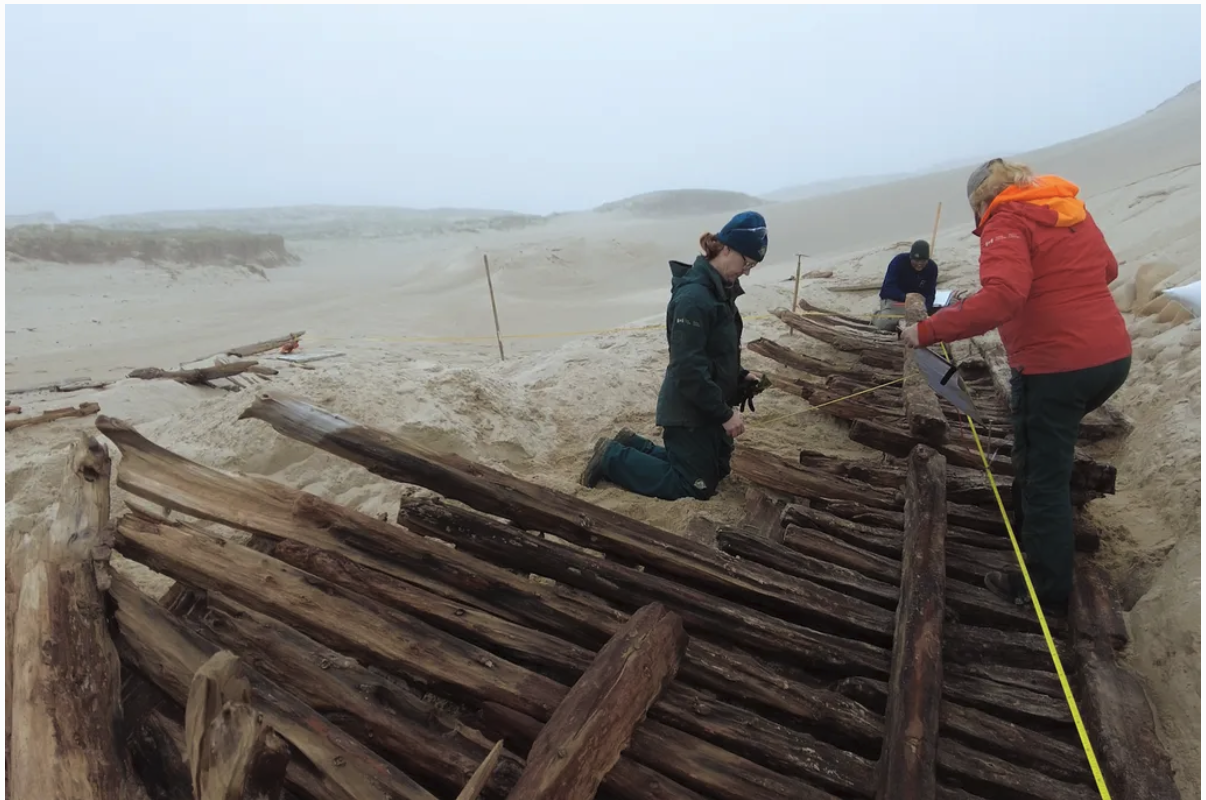
Photo: Parks Canada
The vessel appears to be the “Swift,” a wooden sailing ship that sank off Sable Island in Canada
Two years ago, archaeologists in Canada discovered the remains of a shipwreck on Sable Island, a low-lying sliver of land in the Atlantic Ocean. Now, after months of research and fieldwork, they think they’ve identified the vessel as the Swift, a single-masted ship that sank during the War of 1812.
The wooden ship, a type of sailing vessel known as a Bermuda sloop, was part of a small, four-vessel convoy under the command of Captain Thomas Huskisson, an officer in the British Royal Navy, per the Chronicle Herald’s Josh Healey. The convoy was transporting rum, sugar, silver and prisoners of war from Bermuda to Newfoundland when it encountered a windstorm off the northern coast of Sable Island on September 27, 1812, according to Andrew Sampson of the Canadian Broadcasting Corporation.Three of the ships ran aground and sank: the Swift, the 28-gun frigate HMS Barbadoes and the schooner Emeline. The fourth ship, an unnamed schooner, managed to stay afloat and sailed on to Halifax to get help. Two weeks later, a pair of ships rescued all but one of the crew members.
Sable Island is a remote, uninhabited sandbar that’s protected as a national park reserve by Parks Canada. Located roughly 180 miles southeast of Halifax, Nova Scotia, the crescent-shaped swath is most famous for the hundreds of wild horses that roam its dunes.
Still, Parks Canada staffers like to keep an eye on the island. In February 2024, they were conducting routine monitoring after a winter storm when they found a small piece of exposed wreckage and a segment of copper sheathing, according to a statement from Parks Canada. The copper had been marked with a symbol used by the British Royal Navy—known as a broad arrow—as well as a stamp dated January 1810 in Portsmouth.
Based on these discoveries, archaeologists initially wondered if they had stumbled upon the remains of the HMS Barbadoes. It was the only British naval ship known to have wrecked in the region, and it had been refurbished in Portsmouth in 1810.
In May 2024, they returned to the site and excavated a larger section that was buried deep in a sand dune. They went back again in May 2025 and found an even larger, more complete fragment of a vessel. Both sections appeared to have come from the same ship.
The vessel seemed too small to be the HMS Barbadoes, and it likely had only a single deck and mast. Testing later revealed that the timbers were made of Bermuda cedar. Based on the physical and historical evidence, archaeologists say it appears to be the Swift.
“It’s the first time we’ve been able to associate wreck pieces on the island with a particular wreck event,” Rebecca Dunham, an archaeologist with Parks Canada, tells the Chronicle Herald. “There’s all these little hints that lead us to the current interpretation.”
After researchers thoroughly investigated and documented the timbers, they covered them back up with sand to protect them from the elements. Moving forward, they plan to continue monitoring the site, in case other artifacts emerge. They also hope to learn more about the convoy and the wreck, including how the crew members spent their time while waiting to be rescued.
The Swift is just one of more than 350 shipwrecks recorded since 1583 on Sable Island, which thwarted many captains with its blinding fog and shifting sandbars. It’s one of several treacherous stretches nicknamed the “Graveyard of the Atlantic.”
“It’s the nature of the island,” Dunham tells CityNews’ Natasha O’Neill. “The island itself is not large, but the sandbars continue underwater for quite a distance to the north and south. So it’s like a massive obstacle in the ocean.”
Source: smithsonianmag.com. Sarah Kuta